
Chinese SEO

Get discovered across China's search landscape

From Baidu to AI-powered discovery, we help international brands build search visibility across the platforms Chinese audiences use to research, compare, and make decisions.

Discuss your search strategy

Understanding Chinese search

A Google-centered SEO strategy cannot simply be transferred to mainland China. Search behavior, language, technical accessibility, and the digital platforms people use all require a different approach.

For international brands, effective Chinese SEO starts with understanding how customers research products and services, which sources they trust, and how those discoveries lead to business opportunities. The objective is not visibility everywhere, but visibility where it matters.

Where Chinese audiences search

Platform relevance depends on the audience, category, and decision journey. We prioritize the environments that can support your commercial objectives.

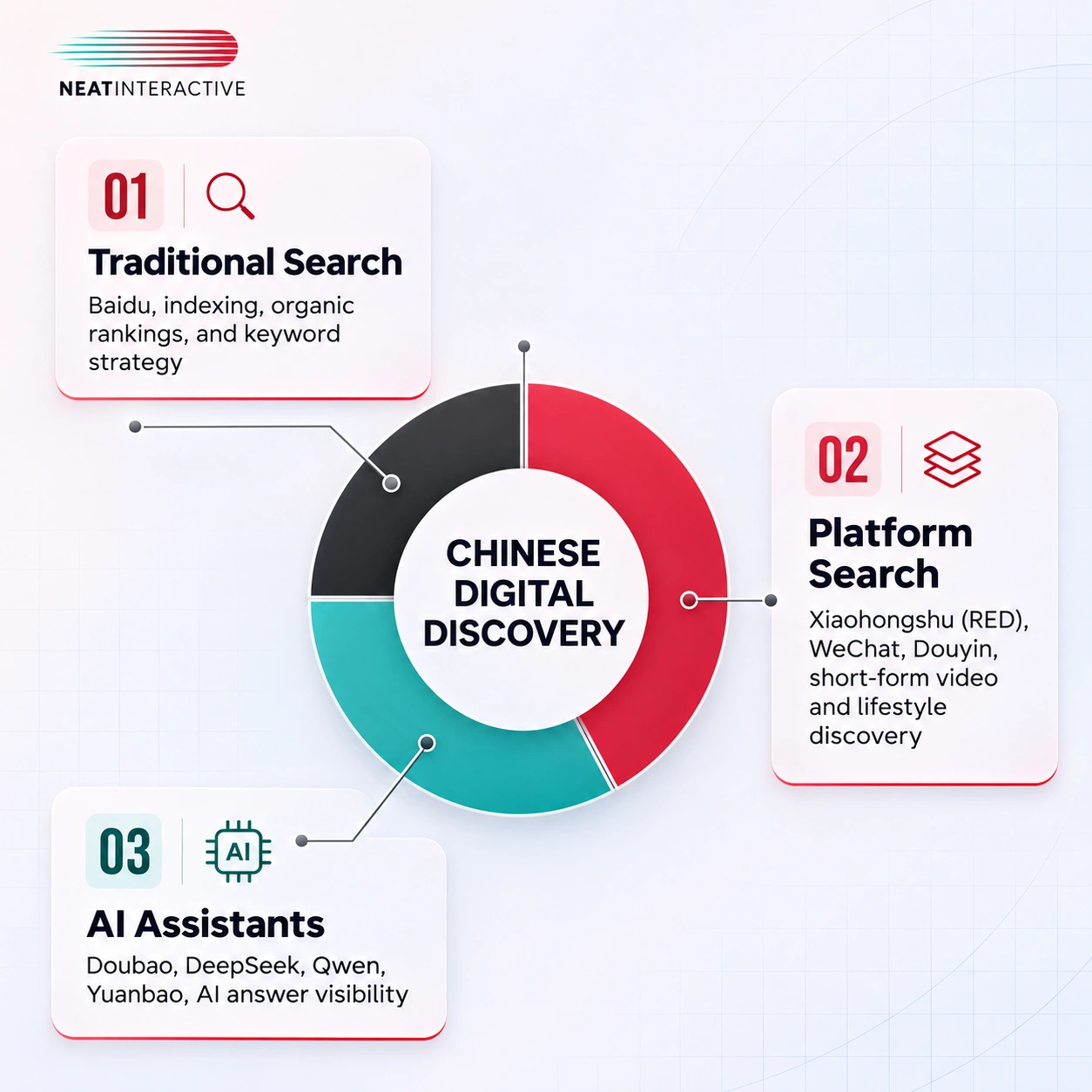
Chinese digital discovery ecosystem connecting traditional Baidu search, platform search across RED, WeChat and Douyin, and AI assistants including Doubao, DeepSeek and Qwen.
The three connected Chinese digital discovery environments shown in the infographic are:
  1. Traditional search. Baidu remains an important route to Chinese-language website content. Our work can address indexing, technical optimization, keyword and content strategy, and organic rankings. Paid search can complement this work under a separate campaign scope and media budget.
  2. Platform search. Xiaohongshu (RED) supports lifestyle and travel research shaped by reviews, experiences, recommendations, and search-oriented content. WeChat supports official account information, Chinese articles, and discovery within the wider WeChat ecosystem. Douyin supports video-led search and discovery, where useful short-form content can improve brand visibility. For location-specific businesses, Meituan, Dianping, and AMAP may also influence how people research and find places.
  3. AI assistants. Doubao by ByteDance, DeepSeek, Qwen by Alibaba, and Yuanbao by Tencent provide conversational discovery. AI assistants are changing how users research brands, compare options, and obtain recommendations. We can improve the clarity and accessibility of brand information, source content, structured information where applicable, and credible third-party presence. We can also test and document how a brand appears in selected AI-generated answers. No business can guarantee citations, recommendations, rankings, direct indexing, or control over model outputs.

Website environments

Search visibility across different website environments

Neat works with Chinese websites hosted both inside and outside mainland China. The right environment depends on the audience, business setup, performance needs, and operational requirements.

Swipe or scroll horizontally to view both hosting options.

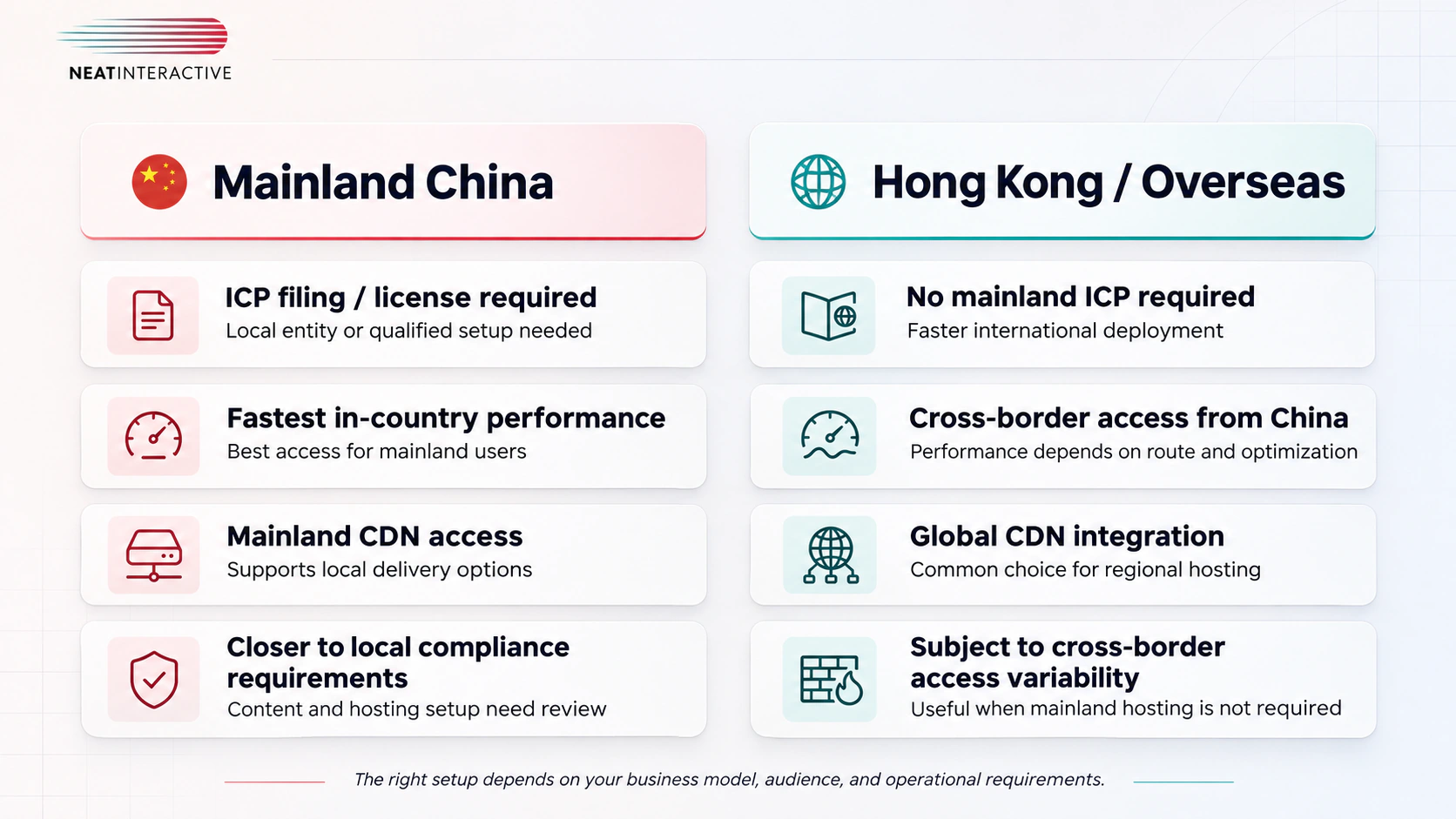
Comparison of mainland China and Hong Kong or overseas website hosting, including ICP requirements, performance, CDN options, and cross-border accessibility.
Mainland hosting generally requires an ICP filing and a suitable local setup, and can provide the strongest in-country delivery. Hong Kong or overseas hosting does not require a mainland ICP filing, but access from mainland China depends more heavily on cross-border routing and technical optimization.

Hosting is one part of Chinese SEO

In either environment, SEO still depends on mainland accessibility, website performance, Baidu crawlability and indexing, technical dependencies, and useful localized Simplified Chinese content. For website development, localization, hosting, maintenance, or ICP-related support, visit our Chinese Website service.

Our Chinese SEO services

One connected approach to search visibility

We connect research, technical work, content, platform visibility, and measurement instead of treating each channel as an isolated activity.

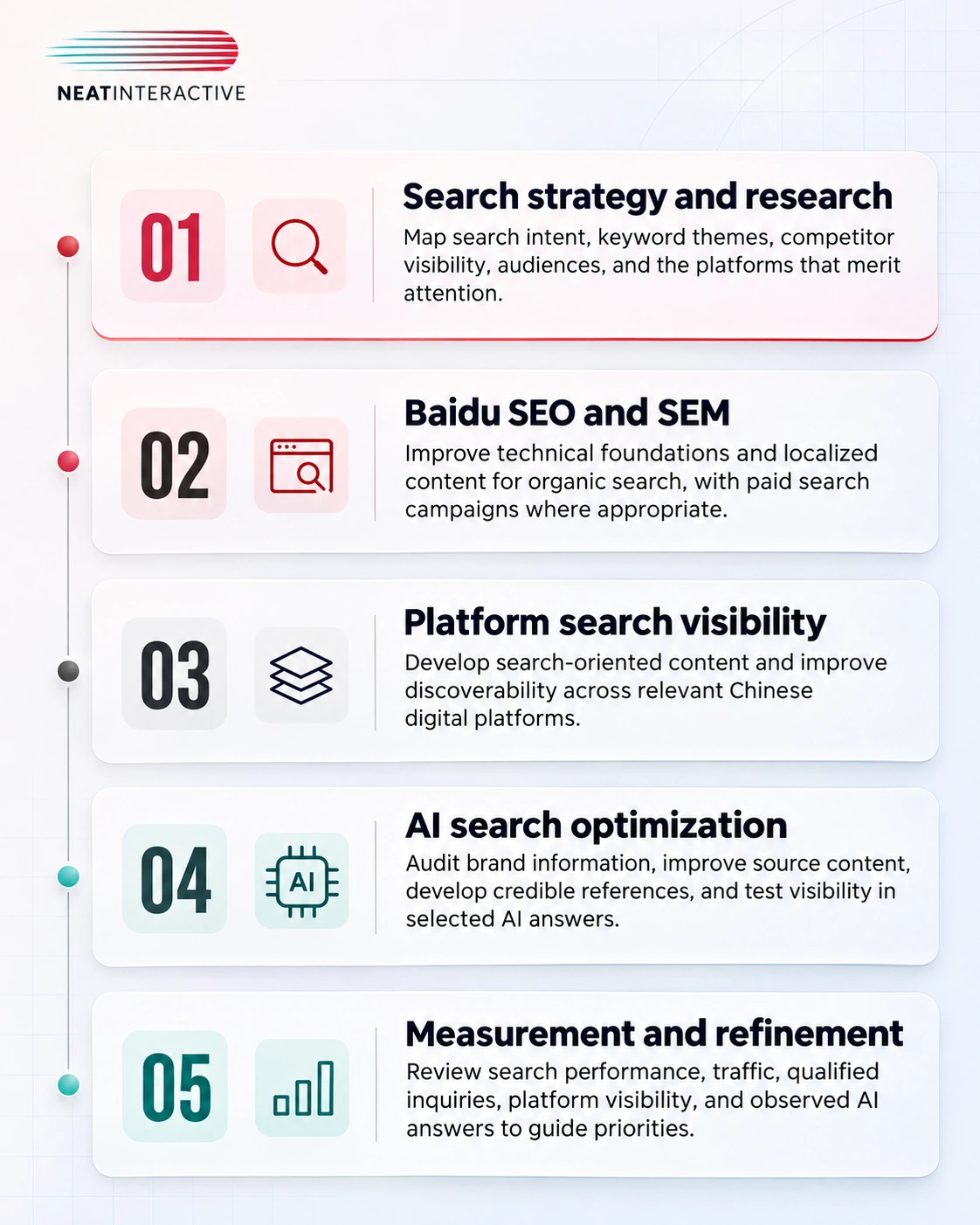
Five connected Chinese SEO services: search strategy, Baidu SEO and SEM, platform search visibility, AI search optimization, and measurement.
The five connected services shown in the infographic are:
  1. Search strategy and research. Map search intent, keyword themes, competitor visibility, audiences, and the platforms that merit attention.
  2. Baidu SEO and SEM. Improve technical foundations and localized content for organic search, with paid search campaigns where appropriate.
  3. Platform search visibility. Develop search-oriented content and improve discoverability across relevant Chinese digital platforms.
  4. AI search optimization. Audit brand information, improve source content, develop credible references, and test visibility in selected AI answers.
  5. Measurement and refinement. Review search performance, traffic, qualified inquiries, platform visibility, and observed AI answers to guide priorities.

Paid media is complementary to organic search and may require a separate campaign scope and media budget.

Experience

Experience in Chinese Search

Neat's experience with established Baidu SEO and SEM work provides a practical foundation for a broader approach to Chinese search visibility.

Centre Point Hotels

Hong Kong-hosted Chinese website

Technical SEO · Baidu SEO & SEM · Performance Monitoring

Neat optimized Centre Point Hotels' existing Chinese-language website, hosted in Hong Kong on a separate domain. Our work included technical code cleanup, page-speed improvements, resolving rendering dependencies affecting mainland China access, Baidu SEO and SEM campaigns, and search performance tracking.

Sansiri

Mainland China-hosted Chinese website

Website Development · Baidu SEO & SEM · Ongoing Maintenance

Neat developed a dedicated Chinese-language website for Sansiri, hosted in mainland China with ICP registration. We subsequently implemented Baidu SEO and SEM campaigns to drive relevant traffic and leads. Our ongoing work includes Chinese-language content optimization and website maintenance.

These examples relate to website and established Chinese search-engine experience. They do not imply that the projects included optimization for Doubao, DeepSeek, Qwen, Yuanbao, or other AI assistants.

Frequently asked questions

Questions about Chinese SEO

Is Baidu still important for Chinese SEO?

Yes. Baidu remains a major search engine in China, particularly for website discovery, product research, and business information. However, Chinese audiences also search within platforms such as Xiaohongshu (RED), WeChat, and Douyin, and increasingly use AI assistants. An effective Chinese SEO strategy considers Baidu alongside these other discovery channels, prioritizing the platforms most relevant to your audience.

Can an overseas-hosted website rank on Baidu?

Yes. Websites hosted outside mainland China can be indexed and rank on Baidu. The important considerations include accessibility from mainland China, page-loading performance, crawlability, and relevant Chinese-language content. Hosting in locations such as Hong Kong can be a practical option for international brands, provided the website is optimized for mainland users and avoids dependencies that interfere with loading or rendering.

Do I need an ICP filing for Chinese SEO?

Not necessarily. An ICP filing is not a requirement simply to appear in Baidu search results. However, websites hosted in mainland China generally require ICP registration, as does the use of mainland China CDN delivery. Websites hosted in Hong Kong or other overseas locations do not automatically require a mainland ICP filing. Depending on the business model and services offered, additional licensing or regulatory requirements may apply.

How does Chinese SEO differ from Google SEO?

Chinese SEO requires a different approach to search behavior, language, technical accessibility, and platform visibility. Websites targeting mainland China generally benefit from Simplified Chinese content, strong mobile performance, and technical optimization that avoids inaccessible third-party services. Baidu also has its own indexing tools and analytics ecosystem. Beyond traditional search, brands must consider how users discover information through Chinese social platforms and AI assistants.

Can businesses optimize for Doubao, Kimi, and other Chinese AI assistants?

Yes, businesses can take steps to improve their visibility in AI-powered discovery, although no agency can guarantee inclusion in AI-generated answers. Chinese AI search optimization involves improving accessible Chinese-language content, maintaining accurate brand information, building credible third-party references, and monitoring how AI assistants describe or recommend a business. The approach varies by platform, and results should be evaluated through ongoing testing rather than conventional ranking positions alone.

Discuss Chinese SEO

Tell us about your market, website, and search visibility objectives. We’ll discuss the environments and priorities most relevant to your business.